Financial Year End UAE 2026: The Year-End Closing Checklist for UAE Companies

Accounting

Financial Year End UAE 2026: The Year-End Closing Checklist for UAE Companies

young man reviews a menu in cafe 2026 09 22 03 42 22 utc
The financial year end UAE 2026 brings together three things that rarely land at once: the last tax period that can qualify for Small Business Relief, a corporate tax return that falls due in September 2027, and the start of mandatory e-invoicing in 2027. Closing your books carefully now makes each of those easier to handle.
RSN Finance has supported businesses across Dubai and the wider UAE since 2018. In this article, we set out what is different about the financial year end UAE 2026, a step-by-step process for closing the books, a VAT and corporate tax checklist, how to prepare for an audit, what to plan for 2027, and when it makes sense to outsource your year-end work.

Financial Year End UAE 2026: What Is Different This Year

financial documents and calculator on a white surf 2026 09 21 17 00 01 utc
Most year-end checklists look the same from one year to the next. This one has three points that deserve attention before you start.

The last tax period that can qualify for Small Business Relief

Small Business Relief treats an eligible resident person as having earned no taxable income for a tax period. To qualify, revenue must not exceed AED 3 million in the relevant tax period and in every previous tax period. The relief applies to tax periods ending on or before 31 December 2026, so a year ending on 31 December 2026 is the last calendar-year period that can use it. Confirm any later change with the FTA before you rely on this.
The relief is not automatic. The FTA has confirmed that eligible businesses must elect it inside their corporate tax return, and that eligibility does not remove the obligation to file. A business that elects it files a simplified return and must keep evidence that revenue has stayed within the threshold. You can read the FTA’s position in its Small Business Relief statement.

Your corporate tax return deadline

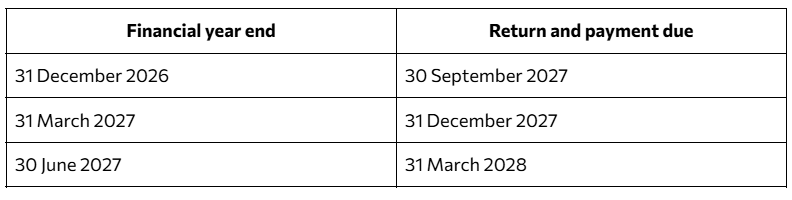
Corporate tax returns, and any tax due, are generally due within nine months of the end of the tax period. For a financial year ending on 31 December 2026, that date is 30 September 2027. The return and the payment share the same deadline, so there is no later payment date.
Screenshot 2026 11 17 185131
If your year end is not 31 December, count nine months from your own year end.

E-invoicing arrives in 2027

Businesses with annual revenue of AED 50 million or more go live on 1 January 2027. Others follow on 1 July 2027. Year end is a sensible point to check that your accounting system and your records are ready. We cover this in more detail in our guides to e-invoicing compliance in Dubai and the e-invoicing deadline July 2027.

Year-End Accounting Dubai: Closing the Books Step by Step

Year-end accounting Dubai businesses complete well follows a fixed order. Each step gives you a clean base for the next, so work through them in sequence. For the wider routine, our bookkeeping services in Dubai page explains how we keep records current through the year.

1. Set the cut-off and agree the timetable

Decide the last date for transactions to count in the year. Agree who is responsible for each task and when it will be finished. A written timetable stops the close from dragging into the new year.

2. Reconcile every bank and cash account

Match each account to the statement at year end. Investigate old unreconciled items and clear or explain them. Include credit cards, petty cash and any foreign currency accounts.

3. Review receivables and bad debts

List every customer balance and check its age. Decide which balances to chase, provide for or write off. If a write-off affects VAT, see our guide to the UAE VAT law for bad debts.

4. Review payables, accruals and unrecorded liabilities

Check supplier balances against statements. Accrue costs that belong to the year but have not been invoiced, such as utilities, professional fees and rent. Search for unpaid items in January and February, because late invoices often relate to the year just ended.

5. Check prepayments and deferred income

Spread costs paid in advance, such as insurance and subscriptions, over the periods they cover. Where customers pay in advance for goods or services, recognise the income only as you deliver.

6. Review fixed assets and depreciation

Update the asset register for purchases and disposals, calculate depreciation and check that assets still in use are recorded.

7. Count and value inventory

Carry out a physical count where you hold stock. Compare it with your records and value items at the lower of cost and net realisable value.

8. Payroll, leave and end-of-service accruals

Reconcile payroll records to the ledger. Accrue unpaid salaries, unused leave and end-of-service benefits as your accounting policy requires.

9. Foreign currency balances

Revalue foreign currency receivables, payables and bank balances at the year-end rate and record the difference.

10. Related party and shareholder balances

Confirm balances with owners, directors and group companies, and agree them with the other party where you can. Record transactions on a consistent basis.

11. Prepare and review the trial balance

Produce the trial balance and read it line by line. Look for unusual balances, accounts that should be zero and accounts with the wrong sign. Fix problems before you produce reports.

12. Prepare management accounts

Produce a profit and loss account, balance sheet and cash flow summary. These are the reports your board, lender or adviser will ask for first. Our accounting services in Dubai team prepares these for clients as part of the year-end process.

VAT and Corporate Tax Checklist for Your Financial Year End UAE 2026

Tax work at year end is mostly about making sure your tax records agree with your accounting records. Use this checklist to test that.

VAT

  • Reconcile output tax and input tax in the ledger to your VAT returns for every period in the year.
  • Check that you hold valid tax invoices for the input tax you have claimed.
  • Review zero-rated and exempt supplies for correct coding.
  • Resolve differences now. If you find an error in a filed return, take advice on voluntary disclosure.
Our VAT consultation team can run a VAT health check if you want a second opinion before the year closes.

Corporate tax

  • Confirm your tax period and that your registration details are current.
  • Prepare your corporate tax computation. The rate is 0% on taxable income up to AED 375,000 and 9% above that. Our corporate tax services in Dubai page explains how this applies to different businesses.
  • Review related party transactions and any items that need adjustment for tax purposes.
  • Decide whether you qualify for Small Business Relief, and make the election in your return if you do.
  • Free zone businesses should confirm their qualifying status. A return is still required even when no tax is due.
  • Keep the records that support your return. The FTA lists core records as transactions during the period, records of assets, records of liabilities and records of ownership interests held at period end. UAE corporate tax rules require records to be kept for seven years.
If you have not yet registered, our guide to corporate tax registration in the UAE in the UAE explains the process. You can also review the FTA’s corporate tax guidance for the legislation and guides.

Audit and Reporting Readiness

An audit is much smoother when your files are ready before the auditor arrives.

Who needs audited statements

Audited financial statements may be required in some cases, including for certain free zone businesses and for some licensing authorities. The requirements depend on your licence and your tax position, so confirm them with your licensing authority and the FTA rather than assume.

Documents an auditor will ask for

Prepare these before the audit starts.
  • Bank statements and bank confirmations
  • Schedules for receivables, payables, fixed assets and inventory
  • Key customer and supplier contracts
  • Payroll records
  • VAT returns and corporate tax filings
  • Board minutes and shareholder agreements
Our guide on how to prepare your business for a financial audit goes into more detail.

Management reports for the board or lender

Prepare a short pack for your board or lender. It should include the year’s results compared with the budget, the cash position and a view of the year ahead.

Looking Ahead: Plan Your 2027 Before the Year Closes

Year end is the natural moment to plan what comes next.

Budget and forecast

A budget fixes your plan for the year, and a forecast updates it as the year unfolds. Our article on budgeting vs forecasting in the UAE in the UAE explains how to use both.

Review your cash flow

Profit and cash are not the same. If the year showed profit but tight cash, look at your payment terms and collections. Our article on cash flow vs profit vs revenue explains why good numbers can still hide cash problems.

Review your accounting system

Check your chart of accounts and your software before the new year starts. A system that can produce structured invoice data will also make e-invoicing easier. Our accounting software services page explains how we help with this.

Accounting Services UAE: When to Outsource Your Year-End

Some businesses close their books well in-house. Others find that year end exposes how stretched the team is. Outsourced accounting services in Dubai can help in both situations.

Signs your team is stretched

  • The monthly close regularly runs late.
  • Bank accounts have unreconciled items from earlier months.
  • VAT returns need corrections after filing.
  • Nobody is sure which year-end tasks are finished.

What to expect from outsourced accounting services in Dubai

A good provider will take on the monthly close, reconciliations, VAT and corporate tax support and reporting. They will also give you a clear timetable for year end. Our accounting services in Dubai cover this range of work, and our SME accounting guide is a useful starting point for smaller businesses.

Questions to ask before you appoint a provider

  • Who will work on my account, and what is their experience?
  • How will you handle VAT and corporate tax alongside the accounts?
  • What reports will I receive, and how often?
  • How do you manage the year-end timetable?

Year-End Closing Checklist at a Glance
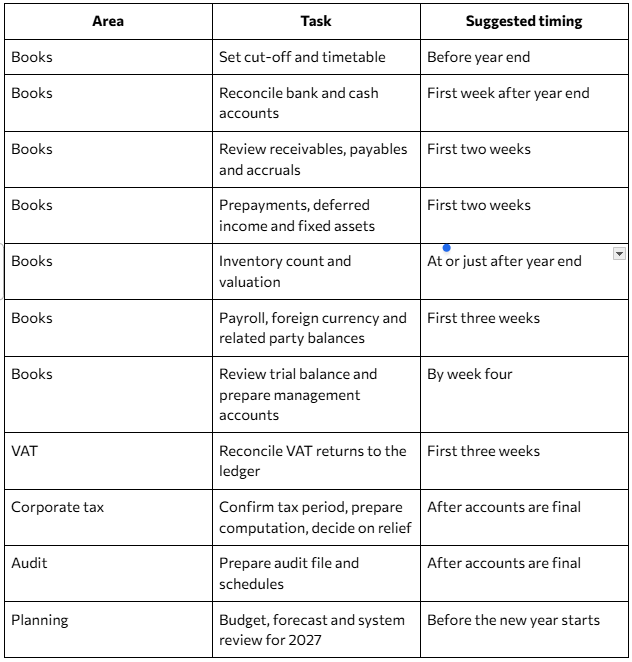
Copy this table into your own tracker and assign an owner to each line.
Screenshot 2026 11 17 193726

Close Your Financial Year End UAE 2026 With Confidence

A careful close gives you accurate accounts, a clean VAT position and a strong base for your corporate tax return. It also leaves you better prepared for e-invoicing in 2027. Start with the timetable, work through the steps in order and ask for help early if your team is stretched.
If you would like support with your financial year end UAE 2026, book a free consultation with RSN Finance with RSN Finance and our team will help you plan the close.

Frequently Asked Questions

What is the financial year end in the UAE?

A UAE business sets its own financial year end in its constitutional documents. Many companies use 31 December, but others use dates such as 31 March or 30 June. Your financial year end decides your corporate tax period and your return deadline.

When is the corporate tax return due for a 31 December 2026 year end?

The return and any tax due must be filed and paid by 30 September 2027. The deadline is nine months after the end of the tax period, and filing and payment share the same date.

Do I have to file a corporate tax return if I owe no tax?

Yes. The FTA has confirmed that registered businesses must file a return for each tax period, whatever the level of income. This includes businesses that owe no tax and businesses that elect Small Business Relief.

What is Small Business Relief and does it apply to my 2026 year end?

Small Business Relief treats an eligible resident person as having no taxable income for the period. Revenue must not exceed AED 3 million in the relevant period and every earlier period. It applies to tax periods ending on or before 31 December 2026, so a 31 December 2026 year end is the last calendar-year period that can use it. You must elect it in your corporate tax return.

What are the main steps in closing the books at year end?

Set a cut-off date, reconcile bank and cash accounts, review receivables and payables, adjust for accruals, prepayments and deferred income, update fixed assets, count inventory, reconcile payroll and foreign currency balances, and review the trial balance. Then prepare your management accounts.

Is an audit mandatory for UAE companies?

It depends on your licence, your free zone and your tax position. Audited statements may be required in some cases, so confirm the requirement with your licensing authority and the FTA. Whether or not it is mandatory, well-prepared records make any review easier.

Should I outsource my year-end accounting in Dubai?

Outsourcing makes sense if your team is stretched, your close often runs late or your VAT and corporate tax work needs more support. A provider can take on the close, reconciliations and reporting. If you want to discuss your situation, you can speak to the RSN Finance team.
Book your FREE consultation today

Looking for an expert corporate tax consultant in Dubai?

Let our experienced team guide you through every step of UAE corporate tax compliance.

The FTA can freeze your business bank accounts to recover unpaid VAT, making it impossible to pay suppliers, staff, or other obligations.

RSN Consultancy Accounting & bookkeeping firm

Read More from our Latest Blogs

Accounting service client

Email us at

admin@rsnfinance.com

Give Us A Call

+971 4 449 6599

Office Location

Accounting and Bookkeeping Consultancy Firm, Office No. 2507, Silver Tower, Opposite Oberoi Business Tower, Business bay, Dubai, UAE.

Newsletter

Subscription Form

Copyright © 2026. All rights reserved.