
E-Invoicing Compliance Dubai: What Happens If You Miss the Deadline
Rajinder Singh Nagiyal
November 5, 2026
E-Invoicing Compliance Dubai: What Happens If You Miss the Deadline

E-Invoicing Compliance Dubai: What the System Asks of Your Business

- Scope: the system covers business to business and business to government transactions. Sales to consumers sit outside it.
- Provider: you cannot connect directly. You must appoint an ASP, which is a technology company accredited by the Ministry of Finance to connect your invoicing to the network.
- Format: your invoice data must meet the national format the system uses. The system is built on the Peppol PINT AE standard, so missing or inconsistent data in your records can cause an invoice to be rejected.
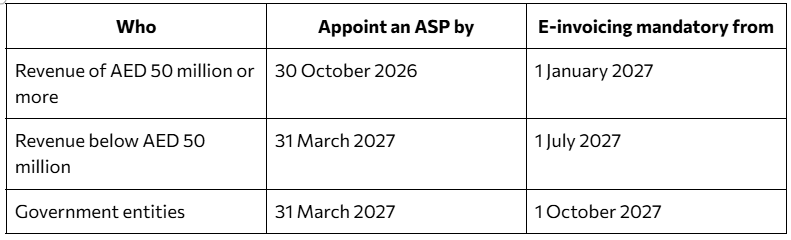
UAE E-Invoicing 2027 Deadlines: Which Date Applies to You
What Happens If You Miss the E-Invoicing Deadline?
The fine for not implementing e-invoicing or not appointing an ASP
- AED 5,000 for the first instance.
- A further AED 5,000 for each month, or part of a month, that the non-compliance continues.
- A maximum of AED 50,000 in any 12 consecutive months.
The rule now applies to both the issuer and the recipient of invoices, not only the business that sends them. The FTA described the monthly fine in its October 2026 announcement as applying for each month or part of a month of delay.
The fine for invoices not issued and sent through the system
The fine for late notice of changes to your registered data
What changed from the earlier decision
- A cap of AED 50,000 in any 12 consecutive months now applies to the implementation fine. Under the earlier decision, a business that stayed non-compliant for a full year could have faced AED 60,000.
- The fine for failing to notify the authority of a system failure has been removed.
- The decision adds protection against the same violation being penalised twice.
The Ministry of Finance did not change the implementation dates. The penalties are lighter in places, but the mandate is not.
The Cost of Missing the Deadline Beyond the Fine
E-Invoicing Compliance Dubai: What to Do If You Have Already Missed Your Deadline
- Confirm your phase. Check your revenue against the AED 50 million line and confirm which of the two dates applied to you.
- Shortlist and appoint a provider.Use the Ministry of Finance list of accredited and pre-approved providers. Compare how each connects to your accounting system and how they handle rejected invoices.
- Complete onboarding on EmaraTax. The FTA lists this as an essential step alongside contracting and integrating with the provider.
- Test before you rely on it. Send and receive real invoices and check how corrections and credit notes behave.
- Keep a dated record. Note when you chose a provider, when you signed and when you went live. If your timeline is ever queried, you can show what you did and when.
- Speak to your tax adviser. Ask what your exposure is and whether any fines already apply to your period.
UAE E-Invoicing Readiness Checklist
| Month | Cost paid | Net cash received | Net cash flow | Cumulative cash |
|---|---|---|---|---|
|
1 |
1.00
|
0.00
|
-1.00
|
-1.00
|
|
2 |
1.00
|
0.00
|
-1.00
|
-2.00
|
|
3 |
1.00
|
0.99 |
-0.01
|
-2.01
|
|
4 |
1.00
|
0.99 |
-0.01
|
-2.02
|
|
5 |
1.00
|
0.99 |
-0.01
|
-2.03
|
|
6 |
1.00
|
0.99 |
-0.01
|
-2.04
|
|
7 |
0.00
|
0.99 |
+0.99
|
-1.05
|
|
8 |
0.00
|
0.99 |
+0.99
|
-0.06
|
All figures in AED millions.
Scope and phase
- Confirm your annual revenue and which phase you are in.
- List the customers and suppliers you invoice or receive invoices from, and mark which are businesses or government.
- Note any group companies and confirm which entity issues each invoice.
Provider selection
- Shortlist providers from the Ministry of Finance list.
- Ask how they connect to your accounting system.
- Ask how rejected invoices are reported and how quickly you can correct them.
- Ask what support they give during testing and after go-live.
Data
- Clean your customer and supplier master data, including names, addresses and tax registration numbers.
- Review item descriptions, tax treatment and units on your most common invoices.
- Check that credit notes link back to the original invoice.
Systems and templates
- Confirm your accounting system or ERP can produce the structured data your provider needs.
- Review your invoice and credit note templates.
- Decide how you will archive invoices and keep records.
People and process
- Name who issues invoices, who corrects rejections and who reconciles to VAT.
- Train sales and finance teams on what changes.
- Update your month-end checklist.
Testing
- Use the voluntary period to test with real invoices before your mandatory date.
- Record every rejection and what caused it.
Clean books make every step easier. If your records are behind, our accounting services in Dubai team can help you catch up before you connect to a provider.
How a VAT Consultant in Dubai Supports Your E-Invoicing Compliance
Checking VAT treatment before go-live. A review of your most common invoices shows whether zero-rated, exempt and standard-rated supplies are being coded correctly.
Reconciling invoice data to VAT returns. Once the system is live, your e-invoice data and your VAT returns should tell the same story. A regular reconciliation catches differences early.
Comparing providers. A tax adviser who knows your VAT position can ask a provider the right questions about how the system handles your transactions.
Ongoing VAT advisory. Rules change. Ongoing VAT advisory in Dubai keeps your treatment and your records aligned as the system matures.
Next Steps for E-Invoicing Compliance Dubai Businesses Can Take Now
Frequently Asked Questions
What is the penalty for missing the e-invoicing deadline in the UAE?
Under Cabinet Decision No. 173 of 2026, failing to implement e-invoicing or appoint an ASP on time costs AED 5,000 for the first instance and AED 5,000 for each further month or part of a month. The total is capped at AED 50,000 in any 12 consecutive months. A separate fine of AED 100 applies to each invoice or credit note not issued and sent through the system, capped at AED 5,000 per calendar month.When does e-invoicing become mandatory in the UAE?
It becomes mandatory on 1 January 2027 for businesses with annual revenue of AED 50 million or more, and on 1 July 2027 for businesses below that level. Government entities follow on 1 October 2027. The last day to appoint an ASP is 30 October 2026 for the first group and 31 March 2027 for the others.Does e-invoicing apply to small businesses and free zone companies?
Yes. A business below AED 50 million is still in scope, and so are free zone companies. They fall into the second group, with an ASP deadline of 31 March 2027 and a go-live date of 1 July 2027. The system covers business to business and business to government transactions, so sales to consumers are outside it.What is an accredited service provider and do I have to appoint one?
An accredited service provider is a technology company approved by the Ministry of Finance to connect your invoicing system to the e-invoicing network. You cannot connect directly, so you must appoint one. The provider receives your invoice data, checks it against the required format and sends it through the network.Can I start e-invoicing before my deadline?
Yes. Voluntary adoption has been open to any business since 1 July 2026. Penalties do not apply to businesses that join voluntarily, so it is a low-risk way to test your systems and train your team before your mandatory date.Do e-invoicing fines apply to the buyer as well as the seller?
Under Cabinet Decision No. 173 of 2026, the implementation fine now applies to an issuer or a recipient that fails to implement the system in line with the timelines. A business that only receives invoices from suppliers should therefore check its own position and not assume the obligation sits with the supplier alone.How can a VAT consultant help with e-invoicing compliance in Dubai?
A VAT consultant helps make sure the tax data in your invoices is correct before it goes into the system. They can review your VAT treatment, reconcile e-invoice data to your VAT returns, help you compare providers and keep your records aligned as the rules develop. If you want support, you can speak to the RSN Finance team.Looking for an expert corporate tax consultant in Dubai?
The FTA can freeze your business bank accounts to recover unpaid VAT, making it impossible to pay suppliers, staff, or other obligations.

Have Any Questions?
Lorem ipsum dolor sit amet, consectetur adipiscing elit. Ut elit tellus, luctus nec ullamcorper mattis, pulvinar dapibus leo.
- +971 4 342 3373
- +971 55 975 9746

Read More from our Latest Blogs


Email us at
admin@rsnfinance.com
Give Us A Call
+971 4 449 6599
Office Location
Accounting and Bookkeeping Consultancy Firm, Office No. 2507, Silver Tower, Opposite Oberoi Business Tower, Business bay, Dubai, UAE.

AREAS WE SERVE
Copyright © 2026. All rights reserved.
